Casco Bay
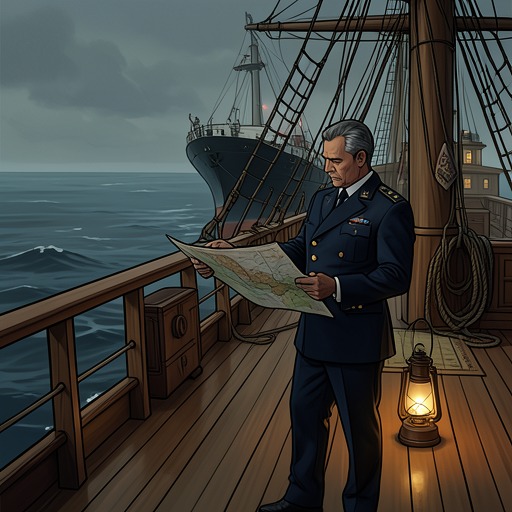
The Good ShepherdCasco Bay is significant as the training ground where Krause acquired anti-submarine knowledge that would inform his later decisions at sea. The Casco Bay anti-submarine school gave him a framework of courses, calculations, and accumulated wartime experience, but the narrative stresses that instruction could not turn an uncertain contest into a mechanical one: no instrument or formula could reveal what a submerged U-boat captain would do next.
Training and Tactical Knowledge
Krause had taken the anti-submarine course at Casco Bay and studied classified pamphlets that digested British experience gathered over two and a half years of warfare against submarines. That training connected technical methods to a body of hard-won operational learning. Mathematicians had calculated the odds of hitting a submerged U-boat; sensitive instruments had been devised and powerful weapons developed. Yet none could make a destroyer captain’s judgment automatic. Whether an enemy would turn to port or starboard, dive deep or remain shallow still had to be guessed, and patience, pertinacity, and judgment could not be supplied by machinery.
Instruction and the Limits of Certainty
Casco Bay also appears as a place where anti-submarine knowledge was taught through stories as well as technical material. A British officer who lectured there was fond of retelling an army anecdote from the previous war: two privates sent their clothes through a newly invented delousing machine, then found that the lice were still alive. One complained that the machine had failed; the other suggested that the lice might nevertheless have been badly frightened. The tale offered a pointed distinction between destroying an enemy and producing an effect that could not be directly verified. In the submarine campaign, a near miss might not sink a U-boat, yet could still frighten its crew or force evasive action.
Lessons Applied at Sea
The training reappears in Krause’s later reasoning about the danger of U-boats and the conditions that might deter them. He recalled the Casco Bay lectures and classified material when weighing the likelihood that submarines would engage under the threat of air attack. With the weather moderating, he considered the prospect of air cover, and he also drew on secret charts showing that U-boats had recently refrained from attacking convoys in the eastern Atlantic. Casco Bay’s importance therefore lies not in promising certainty, but in giving Krause evidence and concepts to test against changing circumstances. The school’s technical knowledge, operational history, and cautionary anecdotes all fed into decisions that still depended on reading incomplete signs and acting without knowing the enemy’s mind.